
Bellevue Bay: From $60 Mil to $110 Mil Overnight. What Happened?
What began as a $60 million indoor water park now carries a reported $110 million price tag. After Bellevue approved up to another $50 million in bonds in a single City Council meeting, we looked at what changed, why officials say more money is needed and why the process is drawing questions.
Bellevue Bay has been years in the making.
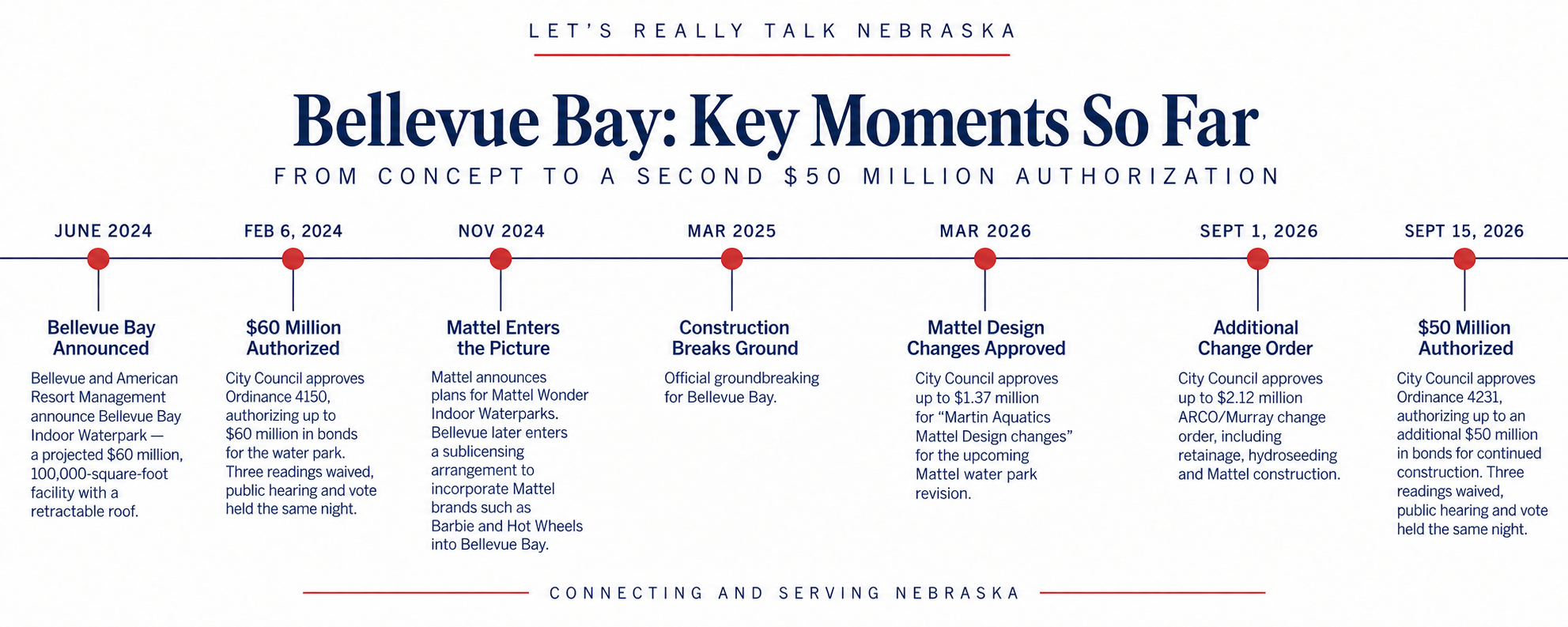
When the indoor water park was publicly announced in 2024, Bellevue described it as a roughly $60 million, 100,000-square-foot year-round attraction with a retractable roof. The project was designed to become an anchor for a much larger entertainment and development district near Highways 34 and 75. The city's current Bellevue Bay page continues to describe a 100,000-square-foot facility.
Since that original announcement, a lot has changed.
Construction began. The project changed contractors. Mattel entered the picture, bringing brands including Barbie and Hot Wheels into the attraction. Design and construction changes followed. And on Sept. 15, the Bellevue City Council approved up to another $50 million in bonds to continue construction. The amended council agenda confirms both the $50 million amount and the request to waive three readings, hold the public hearing and vote that same night.
Local reporting now puts Bellevue Bay's total construction cost at $110 million, while other reporting describes the city as having set aside up to $110 million to complete it.
The distinction between cost and borrowing remains important. The city's bond authorizations establish how much borrowing the city may undertake. They do not, by themselves, establish that every authorized dollar has already been borrowed or spent.
But one thing is clear: Bellevue Bay has become a substantially more expensive project than the one residents were introduced to two years ago.
Why Does Bellevue Need Another $50 Million?
Bellevue officials point primarily to inflation.
Harrison Johnson, Bellevue's Director of Economic and Community Development, told KETV that the project's early estimates relied heavily on pre-pandemic construction figures. Since then, he said, labor and materials have become considerably more expensive, specifically pointing to concrete and fuel costs among the increases affecting construction.
That explanation raises an important question: If Bellevue did not authorize the original $60 million in bonds until 2024, how much had those earlier estimates been updated to account for post-pandemic construction costs before the project moved forward?
The project itself has also evolved since the original authorization. Exactly how much of the additional cost is attributable to inflation and how much is connected to changes in the project's size, design, branding or construction remains unclear.
Despite the higher cost, Bellevue officials remain confident in the project's financial potential. Johnson told 3 News Now that the city expects roughly 600,000 visitors per year and said internal studies project the partnership with Mattel could increase revenue by approximately 35%.
Those are projections. Actual attendance and revenue won't be known until the park opens and begins operating.
Then Came Mattel
One misconception surrounding Bellevue Bay is that it began as a Mattel water park.
It didn't.
Bellevue Bay had already been announced and was under development before the Mattel partnership became part of the project. The branding subsequently brought recognizable properties including Barbie and Hot Wheels into plans for the attraction.
The Mattel component has also resulted in additional design and construction work. City Council records have included Mattel-related design and construction changes as the project has progressed.
Those costs should not simply be added together and characterized as the "cost of Mattel." Individual change orders can include multiple types of work, and Bellevue has not publicly attributed the project's overall increase to the Mattel partnership.
What is clear is that Bellevue sees the branding as financially significant. Johnson says the city's internal studies project approximately a 35% increase in revenue associated with the Mattel partnership. That makes Mattel more than a cosmetic change. It is now part of the city's argument for the project's future earning potential.
The Contractor Changed, Too
Bellevue Bay also underwent a construction transition in 2025, when development of the project moved from MCL Construction to ARCO/Murray.
There is no evidence establishing that the contractor change caused the project's increased costs, and it would be premature to draw that conclusion.
Whether the transition had any effect on the project's overall budget, however, is one of the financial questions that remains unanswered.
Then Came the Sept. 15 Vote
The additional $50 million isn't the only reason Bellevue Bay is drawing renewed attention.
The way the additional borrowing was approved has become a significant part of the discussion.
The Sept. 15 City Council agenda included Ordinance No. 4231, authorizing bonds for continued construction of the Bellevue City Water Park in an amount not to exceed $50 million.
Rather than allowing the ordinance to proceed through readings on three separate days, city staff specifically requested that council waive the three-reading requirement, hold a public hearing and vote on the ordinance that same night. The council did so.
Bellevue did not eliminate the public hearing. Residents had an opportunity to speak before the vote.
But waiving the readings meant there would not be additional council meetings between introduction and final approval, which otherwise could have provided additional time for residents to examine the proposal, ask questions or contact their representatives.
There is also important historical context: Bellevue used an expedited process when the original $60 million authorization was approved in 2024.
Was Bellevue Allowed to Do That?
Yes.
Nebraska law allows a first-class city council, with the required supermajority, to suspend the general requirement that an ordinance be read on three different days.
The procedure wasn't unprecedented for this project, either. The council used an expedited process when it authorized the original $60 million in bonds in 2024.
City officials have pointed to financing considerations as a reason for moving quickly. Bond markets and interest rates can change, and delays can affect what a municipality ultimately pays to borrow money.
Legally and procedurally, the council had the ability to act in a single meeting.
But Could They and Should They Are Two Different Questions
That's where much of the current disagreement lies.
The fact that Bellevue could waive three separate readings doesn't answer whether it should have done so when considering an additional $50 million in borrowing authority.
Three readings would have created more time between introduction and final approval for residents to examine the proposal, understand why the project's financing had increased so substantially, ask questions and contact their representatives. Moving the ordinance through in one meeting eliminated that additional time, even though a public hearing was held before the vote.
On the other hand, city officials argue that waiting can carry a financial cost. Interest rates and bond-market conditions can change, potentially increasing the cost of borrowing.
That makes one question particularly important:
What specific financial cost or risk would Bellevue have faced by allowing the additional $50 million authorization to proceed through the normal three-reading process?
A more detailed answer to that question would allow residents to better understand the tradeoff between the city's stated need to move quickly and the additional public review that three separate readings would have provided.
A $50,000 Typo on a $50 Million Decision
The public notice surrounding the meeting also contained an error that attracted attention.
The original agenda listed Ordinance No. 4231 as authorizing $50,000, rather than $50 million. Mayor Rusty Hike said during the meeting that it was a typographical error and that the supporting ordinance documents contained the correct $50 million amount. KETV independently reported the error and correction.
The mistake does not mean a $50,000 proposal was suddenly transformed into a $50 million proposal during the meeting. The underlying ordinance reflected $50 million.
Still, a three-zero error is noteworthy when the larger public discussion involves both the size of the financial commitment and the amount of time residents had to examine it.
How Is Bellevue Planning to Pay for All of This?
Bellevue's financial argument isn't based solely on selling water park tickets.
Bellevue Bay is intended to anchor the city's Good Life District, with additional hotels, restaurants, retail, entertainment and private development expected around the attraction.
The city's position is essentially that Bellevue isn't simply spending money on a water park. It is investing in an attraction intended to bring hundreds of thousands of visitors into a larger commercial district, where they will spend money at the park and surrounding businesses.
Johnson says Bellevue expects approximately 600,000 visitors annually and believes the project will generate revenue capable of supporting the investment.
If those projections materialize, Bellevue Bay could become a substantial tourism and economic-development asset.
But projections are not realized revenue.
Attendance, ticket sales, visitor spending, tax collections and the pace of surrounding development will ultimately determine whether the financial model performs as expected.
That makes the city's updated feasibility studies, revenue projections and debt repayment structure particularly important now that the project's cost has increased.
Residents Are Divided
The reaction isn't confined to social media.
Local Facebook discussions have generated significant debate over both the additional borrowing and expedited approval process, with some residents questioning the increase and others arguing Bellevue is gaining an attraction capable of changing the city's economic trajectory.
Interviews published by 3 News Now on Friday reflected those competing views. Some residents said they believe the attraction could generate a substantial return and help Bellevue grow. Others questioned whether the city should instead direct more resources toward roads, sidewalks, the library and other existing needs.
Social-media comments and individual interviews aren't scientific measures of Bellevue public opinion. They do, however, illustrate that the current debate extends beyond a simple question of whether people want a water park.
There are really two debates happening at once.
One is about Bellevue Bay itself and whether a major year-round attraction is a worthwhile investment in the city's future.
The other is about how Bellevue got from $60 million to $110 million, how that investment is being financed and how much opportunity residents should have to examine decisions of this size before they are finalized.
Those questions don't require someone to be either for or against the water park.
The Questions That Still Need Answers
Several pieces of information would make Bellevue Bay's financial picture considerably clearer.
What is the city's current complete project budget? How much of the authorized $110 million does Bellevue actually expect to borrow? How much of the original authorization has already been issued, spent or contractually committed?
It is also unclear exactly how the increase breaks down. How much is attributable strictly to construction inflation? How much resulted from changes or additions to the project? How much have Mattel-related design and construction changes added? Did the transition between contractors have any financial impact?
Then there is the revenue side.
What updated attendance and revenue studies support the additional investment? What happens if Bellevue Bay attracts fewer than the projected 600,000 visitors? Which revenues are legally pledged to repay the bonds, and what happens if those revenues fall short?
And finally, there is the process question: What specific financial cost or risk would Bellevue have faced if the additional $50 million authorization had proceeded through the normal three-reading process?
Those answers matter because the project has changed substantially since Bellevue first presented it to the public.
Bellevue Bay began as a roughly $60 million vision for a major indoor water park. It has since added one of the world's most recognizable entertainment brands, undergone design and construction changes, changed contractors and grown into a project now reported at $110 million.
Bellevue is betting that the larger investment will produce a larger return.
Residents won't know whether that bet pays off for years. They can, however, ask how the numbers changed, how the financing works and why another $50 million needed to be authorized now.
Bellevue Bay is currently expected to open mid-to-late 2027.
By Kelly Bohlman | Let’s Really Talk Nebraska
Editor's Note: Let’s Really Talk Nebraska has requested additional information from the City of Bellevue regarding Bellevue Bay's cost, financing and recent bond authorization. This article will be updated when the city responds.
